
For several days in mid-October, a Russian military satellite called Kosmos 2612 closed in on, circled and lingered beside ICEYE-X36, a US-owned commercial radar satellite, getting within roughly 500 meters, according to the orbital tracking company LeoLabs. Analysts describe it as the first known uninvited rendezvous between two active satellites in low Earth orbit, and on October 21 the United States told the United Nations the behavior was consistent with on-orbit weapons operations.
Key points
- Between October 15 and 19, Kosmos 2612 went from about 350 km away to within roughly 500 m of ICEYE-X36, LeoLabs said.
- LeoLabs' Adam Marsh called it "the most advanced and potentially dangerous uncooperative RPO we've observed."
- ICEYE-X36 is owned by ICEYE US, the American arm of Finland's ICEYE, whose radar constellation supplies imagery to Ukraine's military.
- No damage has been reported. By Monday, October 19, the Russian craft was drifting away at about 17 km/h.
- A senior US official, Under Secretary of State Thomas G. DiNanno, said the maneuvers were "consistent with on-orbit weapons operations."
A slow chase, then a sudden sprint
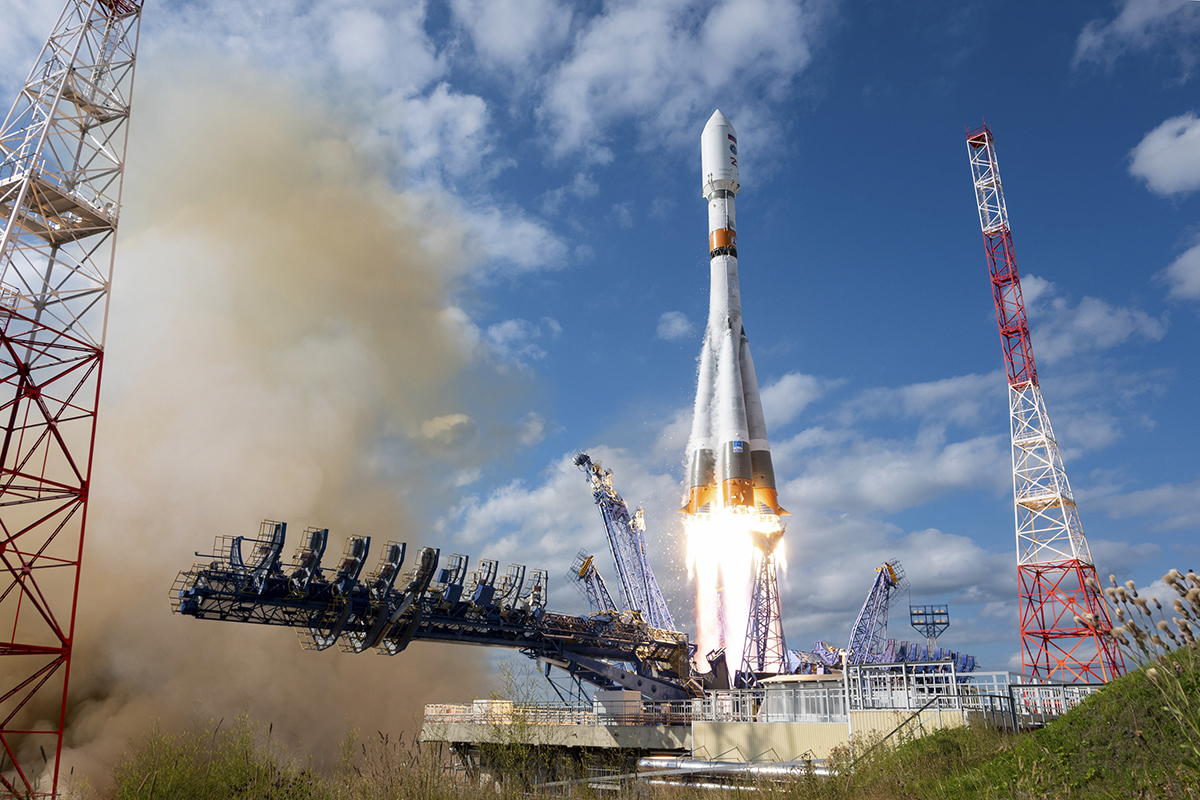
Kosmos 2612 did not appear out of nowhere. It was one of six satellites, designated Cosmos 2609 through 2614, that Russia launched together in April 2026 on a Soyuz rocket from northern Russia. Within weeks, several of them spent considerable fuel shifting their orbits to line up with the plane of ICEYE-X36, an unusual move in low Earth orbit because plane changes are so costly, according to analysts at the Center for Strategic and International Studies (CSIS).
Things stayed relatively quiet until September 30, when Kosmos 2612 began a fresh series of maneuvers that, according to satellite watcher Marco Langbroek, were designed to catch up with the ICEYE spacecraft. On October 15 it moved in quickly. LeoLabs told CNN the gap shrank from about 350 km (217 miles) to under 5 km by early on October 16. By Friday, October 17, the Russian satellite was holding position 2 to 3 km away, then began shifting ahead of and behind its target.
Over the weekend the two spacecraft were within 500 meters of each other, and "likely quite a bit closer than that," Marsh told Ars Technica. LeoLabs cautioned that exact distances are uncertain because of the repeated maneuvers and difficult tracking geometry. At times the two objects were so close its radars struggled to tell them apart.
"This was not a routine conjunction or 'fly by,'" LeoLabs said, describing a controlled approach, close-range loitering, small corrective burns and a controlled departure. The Russian satellite began pulling away on Sunday, October 18.
Two very different spacecraft
ICEYE-X36 is a synthetic aperture radar (SAR) satellite, a type that can image the ground at night and through cloud. It was launched from the United States in 2024 and is operated by ICEYE US, which makes it a US satellite for legal purposes, Victoria Samson of the Secure World Foundation told Breaking Defense. ICEYE has launched about 80 satellites, and in January it announced an expanded agreement to keep supplying Ukraine's Ministry of Defence with radar imagery. The company has never said publicly which specific satellites serve which customers.
Little is known about Kosmos 2612 beyond its launch and its behavior. The US delegation at the UN described it as a Russian Ministry of Defense satellite. ICEYE US said only that it was "aware of the situation and tracking it closely," adding that its constellation is "designed for continuity and resilience."
Washington breaks its silence
For days, US officials said little; the Defense Department declined to comment to Axios. That changed on October 21 at the UN General Assembly's First Committee, which handles disarmament. According to the UN's official meeting summary, the US representative said Kosmos 2612 had shown "threatening behavior by intentionally maneuvering dangerously close to a commercial satellite" and urged Moscow to be transparent.
DiNanno, the State Department's Under Secretary for Arms Control and International Security, repeated the point on X, calling the actions "behaviors consistent with on-orbit weapons operations" and saying they violate "long-established safety thresholds in low Earth orbit," as reported by the ANI news agency. Neither statement claimed that any weapon had been used or that the ICEYE satellite was harmed.
Why it matters
Russia has shadowed US government spy satellites before, but from much farther away. Samson told Space.com that Kosmos 2543 came within about 30 km of the classified USA 245 in 2020. This time the target was a private company's satellite, and the gap was measured in hundreds of meters.
LeoLabs said the event does not prove hostile intent, but shows abilities that could support inspection, intelligence gathering, coercive signaling, interference or "preparation for future counterspace operations." Clayton Swope of CSIS argued that policymakers should assume such a satellite could act against its target. Samson suggested a different motive: Russia may simply be showing off capabilities Ukraine cannot match in space.
There is also a practical safety issue. A space law expert told Axios that while no hard legal limit exists, countries generally stay about six miles apart, because simultaneous maneuvers at close range sharply raise the risk of collision. With commercial satellites now feeding imagery to militaries, the episode raises a question governments have not yet answered: who protects a private spacecraft when a foreign military one pulls up alongside it?
Related coverage: Ukraine's Starlink slowdown · North Korea's internet going dark · the UK army chief's warning about defence sacrifices
Sources
- Ars Technica: Russian spacecraft maneuvers in "extreme proximity" to satellite used by Ukraine (Oct 19, 2026)
- Breaking Defense: Russian satellite stalked ICEYE spacecraft in potentially dangerous on-orbit maneuvers (Oct 19, 2026)
- CNN: Russian satellite approaches another spacecraft without permission (Oct 19, 2026)
- Axios: Russia nears U.S. satellite, raising alarm about intent (Oct 17, 2026)
- Space.com: Russian satellite gets too close for comfort to a commercial US satellite likely used by Ukraine (Oct 21, 2026)
- CSIS: Could Russia Be Poised to Use an On-Orbit Weapon Against a Commercial Satellite? (Oct 15, 2026)
- UN Meetings Coverage: First Committee Debates Pathways to Prevent Weaponization of Outer Space (Oct 21, 2026)
- Business Standard / ANI: US accuses Russia of exhibiting 'threatening satellite behavior' in space (Oct 22, 2026)



Comments