
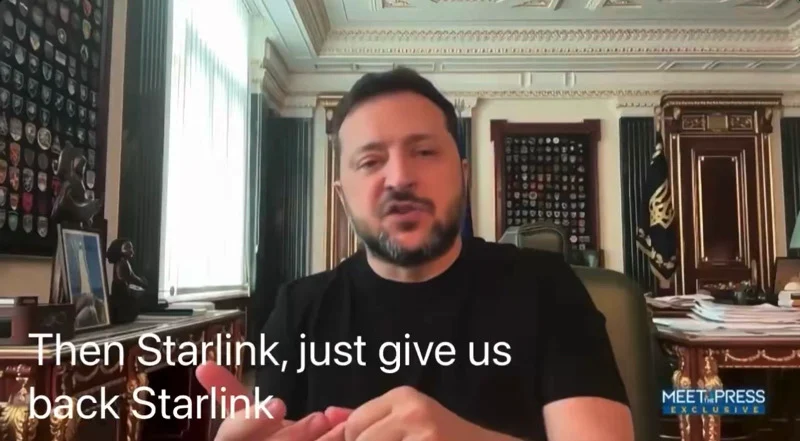
A sudden speed cap on the satellite network Ukraine's military depends on has set off a dispute between Kyiv, Washington and Elon Musk. President Volodymyr Zelenskyy says the restrictions have hurt his forces and have not been fully lifted. The Wall Street Journal now reports that Musk ordered the slowdown, while President Donald Trump says he "was not involved."
Key points
- On October 14, a Zelenskyy adviser said SpaceX had capped Starshield connections for terminals moving faster than 160 km/h (100 mph), which disrupted drone operations.
- The Wall Street Journal reported on October 20 that Musk ordered the slowdown, citing unnamed US officials and people familiar with the matter.
- Musk had earlier said limits on Starshield are "decided by the US military and ultimately POTUS." Trump denies ordering anything.
- Secretary of State Marco Rubio says access is governed by a private contract and is a decision for SpaceX.
- Zelenskyy says speed restrictions remain "in different parts of the front."
What happened
Starshield is a military-grade version of SpaceX's Starlink network. According to NPR, the US Defense Department has shared it with Ukraine since 2024 at a cost of billions of dollars.
Zelenskyy adviser Serhii Beskrestnov wrote on Telegram on October 14 that SpaceX had imposed a 160 km/h limit, Al Jazeera reports. That matters because Ukraine's interceptor drones fly fast to catch Russian drones. "Our defence forces received no prior warning regarding this restriction, and it has led to the disruption of a number of missions," he said. Ukraine's Ministry of Defence confirmed on October 15 that service had resumed, but Zelenskyy says the problem has not gone away. "Unfortunately, we have established that the equipment stops functioning at speeds of 130–161 kilometers per hour in various sectors of the front," he wrote on X, as quoted by Ars Technica.
Zelenskyy explained on X why the network matters: "We use Starlink to intercept the jet fighters that are hitting our civilians and killing families," he wrote, adding that soldiers on the front line receive food and water by drones that rely on Starlink, NPR reports.
Who ordered it?
The accounts conflict:
- Musk said on X on October 14 that "Starshield systems are owned and controlled by the US government. Any limits on speed or usage are decided by the US military and ultimately POTUS."
- Reuters reported on October 15 that the order "came from inside the White House," citing two US officials and a Western official, according to Ars Technica.
- The Wall Street Journal reported that "Elon Musk ordered the slowdown," and that he spoke with senior officials, including Trump, before imposing it. Some US officials told the paper Musk acted alone. CBS News reported that Musk held several conversations with administration officials beforehand.
- Trump said on October 21: "I don't know who did it, but I was not involved," CNBC reported.
- Rubio said: "That's a private company. The president doesn't run that company and can't direct that company to do anything," according to Ars Technica. Defense Secretary Pete Hegseth also described it as a terms-of-service matter for SpaceX, Al Jazeera reports.
None of these accounts has been officially confirmed, and SpaceX has not publicly explained the decision.
The Starlink vs Starshield confusion
Part of the dispute is about which system Ukraine uses. Rubio said on October 17 that Ukraine has only commercial Starlink, not Starshield, and wants Starshield for deep strikes in Russia. Ars Technica notes that earlier Bloomberg reporting described Pentagon contracts giving Ukraine Starshield access, and Zelenskyy says both services have been affected.
A wider rift
The slowdown came after Musk and Trump both criticised Ukraine's attacks on Russian refineries, Ars Technica reports. NPR adds that earlier this month Trump moved to ease US sanctions on Russia and said, "I think it's time for Ukraine to get a new president," after Zelenskyy criticised the move.
In Congress, a bipartisan group of senators has asked the Pentagon's inspector general to investigate, NPR reports. Republican Senator John Cornyn told CNBC he doubts Musk would throttle the service without "at least the acquiescence of the White House." Zelenskyy, meanwhile, says Ukraine is working with Norway and other partners on new satellite communication options.
A note on a viral quote: posts on X attribute the line "Just give us Starlink back. If you refuse, Ukraine will survive" to Zelenskyy. We could not find this exact wording in an official transcript or a major news report, so treat it as unverified.

Why it matters
Satellite internet is now a frontline tool, used for drones, communications and supply. This episode shows the risk of relying on privately run infrastructure in wartime: if one company can change the rules overnight, an army's capabilities can change with it. An inspector general review, if it goes ahead, may give the first official answer about who made the call.
Sources
- Ars Technica: Report says Musk ordered Starlink slowdown
- The Wall Street Journal: Musk ordered Starlink slowdown that blindsided Ukraine
- Al Jazeera (AP/Reuters): Ukraine's access to Starlink a decision for Musk, Rubio says
- CNBC: Trump denies ordering Starlink slowdown
- CBS News: Musk chose to restrict Ukraine's access, sources say
- NPR: Ukraine and the US are at odds over Starshield


Comments