

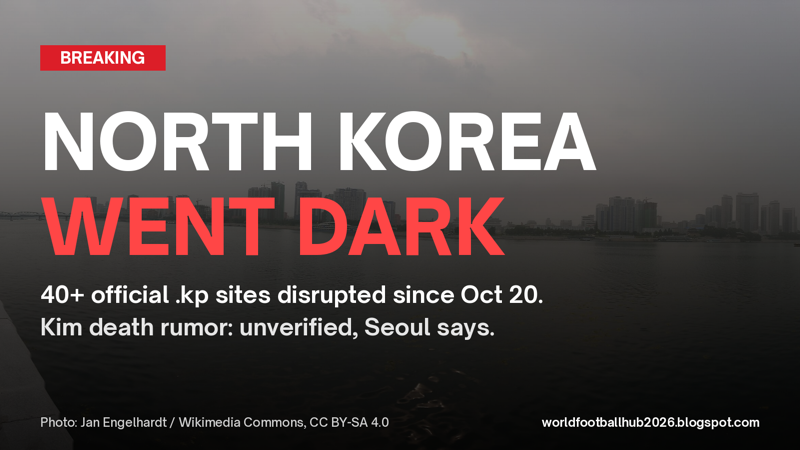
Photo: Pyongyang skyline. Jan Engelhardt, CC BY-SA 4.0, via Wikimedia Commons
For about two days, almost the whole of North Korea's public internet stopped working. State media, the foreign ministry, and even the national airline's booking site all went down together. It happened while false claims that Kim Jong Un was dead were spreading online. The timing invited conspiracy theories, but the confirmed facts are stranger and less dramatic.
Key points
- 40+: official .kp websites down or unstable (Yonhap via Reuters)
- ~6 hours: BGP routing disruption on October 20 (Telecom Observer)
- ~19 of 24 hours: KCNA offline in the first day (JoongAng)
- 1,024: total public IPv4 addresses assigned to North Korea (IPinfo)
- 28: public .kp domains revealed in a 2016 DNS leak (GitHub)
- 0: confirmed claims of responsibility
What happened
The trouble began around 11 a.m. on Tuesday, October 20, 2026, Korea JoongAng Daily reported. Sites that went offline included KCNA, Rodong Sinmun, Minju Choson, Voice of Korea, the Naenara portal, the foreign ministry, Air Koryo and the DPRK Portal. Yonhap counted more than 40 official .kp sites that were down or unstable, according to Reuters.
The monitoring service Telecom Observer detected almost six hours of disruption to North Korea's BGP routing, the system that tells the rest of the internet how to reach the country. It ran from 18:10 to 23:50 GMT on October 20. On October 21, NetBlocks posted on X that its network data showed "an ongoing disruption to North Korea's already limited internet connectivity."
The outage came and went. Reuters said KCNA and Rodong Sinmun were reachable again by 00:43 GMT on October 21. Even so, JoongAng reported that KCNA was down for about 19 of the first 24 hours. Most other sites added up to only about 10 minutes of uptime on Wednesday morning.
The rumor vs. the facts
Since the weekend, overseas social media has carried claims that Kim died after a brain hemorrhage. The Korea Herald traced the claims to posts by Wanjun Xie, a US-based Chinese dissident. He offered no medical records, no eyewitnesses and no other evidence anyone could check. According to the Herald, Xie has spread unverified claims before about Chinese President Xi Jinping's health.
South Korean diplomatic and security officials said they had no information to back the claims, and a Unification Ministry official called them "unverified rumors," Yonhap and the Herald reported. There is no evidence that Kim is dead.
North Korea's response
Pyongyang never mentioned the rumor directly. On October 20, KCNA reported that Kim had visited a clothing and footwear exhibition in Pyongyang the day before. Photos showed him with his wife, Ri Sol-ju, and daughter, Ju-ae. In one image he looks at a pair of pink children's sneakers. Outside observers cannot confirm exactly when the photos were taken.
The internet reacts
X turned the story into jokes almost right away. "The internet kills Kim Jong Un at least twice a year at this point," one user wrote. Another joked that the internet had "arranged a leadership transition—all before North Korea apparently got the memo." A post by @InsiderWN ("North Korea suffers internet disruptions, .kp domain sites go dark.") got more than 36,000 views. Posts about "North Korea" and "internet" rose from 59 on October 20 to 295 on October 21, according to X's own post counts.
Has this happened before?
Yes. In January and February 2022, almost every North Korean website dropped offline again and again. WIRED later reported that a lone American hacker known as "P4x" said he did it as revenge for North Korean spies targeting him. He was later identified as Alejandro Caceres. This time, nobody has claimed responsibility, and analysts found no evidence of an outside attack.

Why it matters
North Korea's link to the global internet is tiny and fragile. JoongAng reports that it depends on China Unicom. Park Chan-am, CEO of the South Korean security firm Stealien, told Yonhap that unstable power can knock out border routers and cause "this kind of pattern." He added that a similar outage in June was judged to be an internal problem. When a country this closed goes quiet online, rumors move into the gap, which is how a routing failure ended up mixed with a fake death story.
FAQ
Is Kim Jong Un dead?
There is no evidence he is. Seoul calls the claims unverified, and state media released new photos on October 20.
Did hackers cause the outage?
Nobody knows yet. No one has claimed it, and analysts have found no evidence of an outside attack.
Can ordinary North Koreans use the internet?
Mostly not. Most people only have Kwangmyong, a closed domestic intranet. Global access is kept for a small elite.
Are the sites back?
Only on and off so far. As of October 22, reports describe access that keeps dropping in and out.
Related coverage: the PHP2Shell vulnerabilities and how to patch them · a Russian satellite circling a US-owned radar satellite · Ukraine's Starlink slowdown
Sources
- Korea JoongAng Daily: North Korea's websites go dark as Kim death rumor fuels speculation
- bdnews24.com (Reuters): North Korean websites down
- NetBlocks on X (October 21, 2026)
- Yonhap News Agency
- The Korea Herald
- The Financial News (Korea)
- BBC News
- WIRED: The hacker who took down North Korea's internet
- WIRED: P4x's identity revealed
- IPinfo: AS131279 (Star JV, North Korea)
- GitHub: North Korea DNS leak (2016)
- Wikipedia: Internet in North Korea
- Image: Pyongyang skyline, Jan Engelhardt, Wikimedia Commons (CC BY-SA 4.0)




Comments