
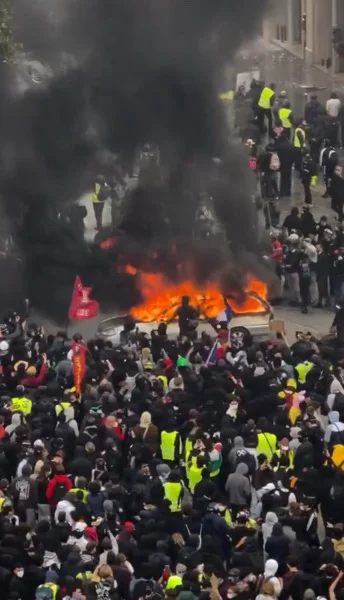
France is facing renewed social tensions as a wave of student demonstrations and wider public discontent reportedly brings together protesters concerned about education, the rising cost of living, and the country's economic future.
According to a circulating account, what began as student protests in a Paris suburb in September has developed into a broader movement involving students, trade unions, farmers, taxi drivers, and supporters of the Yellow Vest movement.
The reported demonstrations reflect growing frustration over public services, household expenses, and uncertainty about opportunities for younger generations.
Key points
- Protests that reportedly began among students have widened into anger over the cost of living.
- Riots on October 17 left a historic town hall torched and led to 1,800 arrests, Gulf News reports.
- Students' reported concerns include overcrowded classes, teacher shortages and the Parcoursup admissions system.
- Many figures in circulating accounts, including turnout and fuel prices, have not been independently confirmed.
- President Macron has rejected foreign leaders' claims that migrants are to blame.
What has been confirmed
Much of the detail in this story comes from a circulating account that we could not fully verify, so the figures below are labelled as reported. Major outlets have confirmed the wider unrest. NBC News reports that protests over soaring living costs have led to widespread rioting and looting in France. According to Gulf News, protests on Saturday, October 17 left a historic town hall torched and led to 1,800 arrests, six months before the election to replace President Emmanuel Macron.
The unrest has also become an international political issue. President Donald Trump wrote on Truth Social that "France is burning!" and urged the country to "close your Borders." Macron rejected claims by foreign leaders blaming migrants, calling some of the comments "as unacceptable as they are stupid," NBC News reports. He also said AI-generated images had shown "scenes that never actually happened in France."
Why Are Students Taking to the Streets?
Education is at the center of the reported protests.
The account claims that more than 1,000 high schools were affected during the early stages of the movement, with hundreds allegedly closing on a single day.
Students' reported concerns include overcrowded classrooms, shortages of substitute teachers, insufficient access to school nurses and counselors, and deteriorating school buildings.
Another major issue is Parcoursup, France's platform for managing applications to higher education institutions.
Critics argue that the system can leave students uncertain about their academic futures, raising questions about fairness, transparency, and access to university places.
For many young people, the demonstrations are about more than school conditions. They are also about whether the education system can provide a realistic path toward a secure future.
The Government's Response
The circulating account says the Education Ministry responded by opening a dialogue initiative and promising additional substitute teachers.
However, some protesters reportedly viewed the measures as insufficient, arguing that temporary commitments would not resolve deeper problems involving staffing, facilities, and educational opportunities.
The account also cites figures relating to arrests and injuries among protesters, students, and police officers.
These numbers require independent confirmation from official government statements and reliable reporting before they can be treated as established facts.
From Student Demonstrations to a Cost-of-Living Protest
The movement reportedly expanded beyond schools as concerns about household expenses entered the debate.
Fuel prices, energy bills, and the cost of everyday necessities have become important issues for households across Europe, including France.
The circulating account claims that fuel prices exceeded €1.80 per liter and that household gas prices increased in October.
These economic pressures have reportedly encouraged some demonstrators to connect the education crisis with the wider struggle to make ends meet.
The comparison with the Yellow Vest movement is significant. Beginning in 2018, that movement became a major expression of public anger over fuel taxes, living costs, and perceived economic inequality.
The reported use of similar slogans suggests an attempt to connect current grievances with France's earlier wave of social protests.
A Broad Coalition of Protesters
According to the account, demonstrations on October 17 brought together several groups with different concerns.
Students called for improvements in education, while Yellow Vest supporters focused on purchasing power and economic fairness. Trade unions, farmers, and taxi drivers were also described as participants.
The account gives competing estimates of the nationwide turnout, with the Interior Ministry figure reportedly lower than the number cited by trade unions.
Such differences are common in large demonstrations. Official authorities and organizers may use different methods to estimate attendance, making it important to distinguish between their respective figures.
The slogan reportedly used by demonstrators — "Youth and Yellow Vests, One Struggle" — reflects an effort to unite separate movements around shared economic and social concerns.
France's Debt and Economic Challenges
France's public finances are another important part of the broader debate.
High public debt and the cost of government borrowing can limit a government's ability to increase spending while maintaining fiscal stability.
The circulating account claims that French borrowing costs reached particularly high levels and that Moody's placed the country under negative review. These specific financial claims should be checked against current market data and the agency's official announcements.
Debates over the 2027 budget could add to public tensions if proposed savings, tax changes, or reductions in services affect households already struggling with higher expenses.
However, the relationship between public debt, government spending, and the cost of living is complex. The impact of any budget depends on the specific measures adopted and which groups are affected.
Reports of Clashes and Property Damage
The account also describes incidents of violence and property damage in several French cities, including Paris, Marseille, Lyon, and Limoges.
It alleges that police used tear gas and water cannons and that investigations into possible police misconduct were opened.
These claims require confirmation from police statements, judicial authorities, or reputable news organizations.
It is important to distinguish between peaceful demonstrators and individuals involved in violence. Reports of clashes do not mean that all participants in a protest were violent, just as peaceful participation does not rule out the possibility of serious incidents.
The handling of demonstrations can itself become a source of controversy, particularly when questions arise over the proportionality of police tactics and the protection of civil liberties.
Are Most Demonstrations Peaceful?
The circulating account characterizes the overwhelming majority of the movement as peaceful and describes demonstrations featuring signs about students' futures and deteriorating public services.
However, its claim that 90% of the movement was peaceful has not been independently established here.
Large demonstrations can include peaceful marches, isolated confrontations, and incidents of property damage at different times or locations. A reliable assessment requires evidence covering the demonstrations as a whole.
The distinction matters because public debate can become distorted when isolated incidents are used to characterize every participant.
What Happens Next?
The next stage of the movement will depend on several factors, including the government's response, the willingness of student groups to continue mobilizing, and whether trade unions or other organizations join future demonstrations.
The account suggests that some students are considering further action after the autumn school holiday, while the government may seek to address grievances through discussions and policy proposals.
Whether these efforts lead to lasting changes remains uncertain.
The political consequences would also depend on the scale and duration of the protests, the public's response, and the government's ability to address concerns over education and living costs.

Why it matters
France has a long history of large demonstrations influencing national political debates. When students, workers, and other groups unite around shared grievances, protests can become a wider discussion about economic priorities and the social contract between citizens and the state.
The reported movement highlights issues that extend beyond France: pressure on public services, rising household expenses, concerns about educational opportunity, and disagreements over how governments should manage public finances.
Other European countries face some of these challenges as well, although their economic conditions and political responses differ.
The Bigger Picture
If the reported developments are confirmed, the demonstrations would represent more than a dispute over school conditions.
They would reflect broader frustration among people who feel that education, household finances, and future opportunities are becoming increasingly difficult to manage.
For students, the central concern is whether the education system can provide a fair chance at success. For families, it is whether wages can keep pace with essential expenses. For policymakers, it is how to respond to these pressures while managing public finances and maintaining public confidence.
The coming weeks will be important in determining whether the movement loses momentum, leads to negotiations, or develops into a larger national campaign.



Comments