

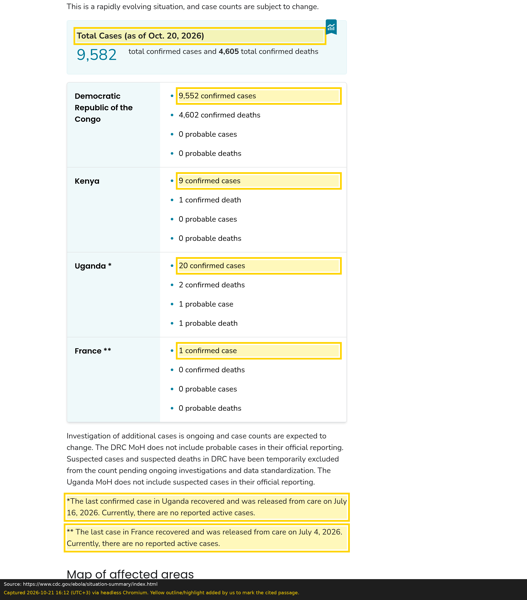
Ebola is back in the headlines, and this time the cause is a strain most people have never heard of. The Ebola outbreak 2026 is driven by Bundibugyo virus, and no approved vaccine or treatment exists for it. As of October 20, 2026, the U.S. CDC counts 9,582 confirmed cases and 4,605 confirmed deaths, which makes it the second-largest Ebola outbreak on record.
Last updated: October 21, 2026
This week Kenya confirmed its ninth case, and Nigeria confirmed an imported case in Abuja. Since then, Ebola posts on X have roughly tripled.
The short answer: for most people outside the affected areas, the CDC rates the risk as low. According to the World Health Organization, Ebola spreads through direct contact with the blood or body fluids of someone who is sick or has died, and people cannot pass it on before they have symptoms. Below you'll find what's happening, the symptoms to watch for, and what it means if you travel.
Key points
- The 2026 outbreak is caused by Bundibugyo virus, one of three Ebola-family viruses known to cause large outbreaks.
- 9,582 confirmed cases and 4,605 deaths as of October 20, almost all of them in the Democratic Republic of the Congo (DRC).
- Kenya has 9 cases (1 death), all in one cluster with no community spread. Nigeria confirmed one imported case on October 20.
- Symptoms appear 2 to 21 days after exposure, starting with fever, fatigue, muscle pain, headache and sore throat.
- No licensed vaccine or treatment exists for Bundibugyo yet. A vaccine trial called Tumaini is about to start in the DRC.
- WHO advises against border closures, but some countries, including the U.S. and El Salvador, have imposed travel restrictions.
What is happening with the Ebola outbreak in 2026?
The outbreak was declared in the Democratic Republic of the Congo on 15 May 2026, according to WHO's Africa office. The CDC says it is the 17th Ebola outbreak in the DRC, with confirmed cases in Bas-Uele, Haut-Uele, Ituri, North Kivu, South Kivu, South Ubangi and Tshopo provinces.
The speed is what has experts worried. The CDC reports that this outbreak passed 1,000 confirmed cases within 40 days of the response starting. The 2018 DRC outbreak took about 235 days to reach the same number (CDC).
Kenya: first-ever Ebola cases
Kenya had never recorded an Ebola case before this month. WHO reports that a Kenyan citizen who fell ill in the DRC travelled by road to Kampala, Uganda, on 2 October, then flew to Nairobi on 3 October. He was isolated on arrival but died on the night of 5 October.
Health teams identified 130 contacts, and 127 of them were in quarantine by 16 October (WHO). By 20 October, Kenya had confirmed nine cases and one death. The later cases were all relatives or health workers who were already in quarantine when they fell ill, and the CDC notes there has been no community spread. The ninth case was a 24-year-old man, a close family member of the first patient (Xinhua).
Nigeria: an imported case in Abuja
On 20 October, Nigeria became the fifth country to detect the virus since the outbreak was declared. The patient is a woman who had recently travelled to Uganda. Her symptoms began on 7 October, four days after she arrived in Nigeria. She went to a private hospital in Abuja on 11 October, and the lab confirmed Bundibugyo virus on 20 October. She is in isolation, and 44 contacts are being monitored (WHO Africa).
Ebola cases by country (2026 outbreak)
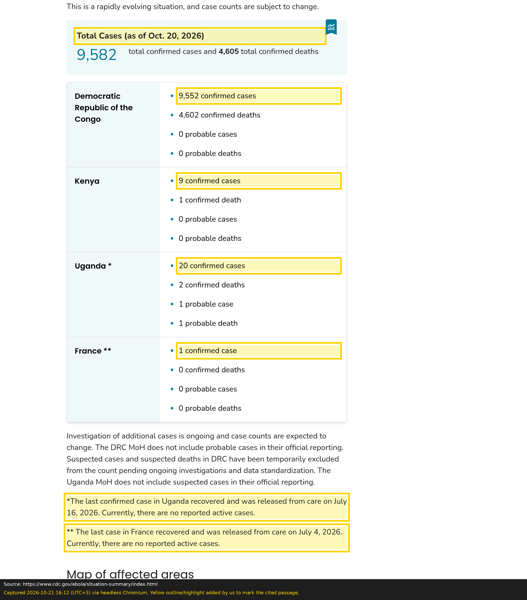
- DR Congo: confirmed cases 9,552; confirmed deaths 4,602; current status Active, spreading
- Kenya: confirmed cases 9; confirmed deaths 1; current status Single cluster, no community spread
- Uganda: confirmed cases 20, with 1 probable; confirmed deaths 2, with 1 probable; current status No active cases; outbreak ended August 2026
- France: confirmed cases 1; confirmed deaths 0; current status Travel-related; patient recovered July 4
- Nigeria: confirmed cases 1; confirmed deaths None reported; current status Patient isolated; 44 contacts monitored
Sources: CDC situation summary, Oct 20, 2026; WHO Africa on Nigeria; WHO Africa on Kenya and Uganda. The CDC total above does not yet include Nigeria.
What is Bundibugyo virus?
"Ebola" is really a family of viruses. WHO explains that six species have been identified, and three of them are known to cause large outbreaks:
- Ebola virus (EBOV), the best-known strain, which causes Ebola virus disease
- Sudan virus (SUDV), which causes Sudan virus disease
- Bundibugyo virus (BDBV), which causes Bundibugyo virus disease (BVD)
Bundibugyo virus was first detected in Uganda in 2007 (WHO Africa). Across all Ebola diseases, WHO puts the average fatality rate at around 50%, with past outbreaks ranging from 25% to 90%. Fruit bats are thought to be the natural hosts.
Why the strain matters: the vaccines and antibody treatments you may have read about in past outbreaks only work against the original Ebola virus. They are not approved for Bundibugyo (WHO).
How does Ebola spread?
According to WHO, a person can catch Ebola through direct contact, via broken skin or mucous membranes (such as the eyes, nose or mouth), with:
- the blood or body fluids of a person who is sick with Ebola or has died from it
- objects or surfaces contaminated with those fluids, such as bedding or clothing soiled with blood, vomit or faeces
- infected animals such as fruit bats, monkeys, apes or forest antelope, especially those found sick or dead
Two facts matter most:
- People cannot spread Ebola before they have symptoms. They stay infectious as long as the virus is in their blood.
- Caregivers and funerals carry the highest risk. Health workers are often infected when infection-control precautions are not strictly followed, and burial rituals that involve touching the body can also spread the virus.
Ebola symptoms: what to watch for
The Ebola incubation period, the time from infection to the first symptoms, is 2 to 21 days (WHO).
Early symptoms (often sudden)
- Fever
- Fatigue and general malaise
- Muscle pain
- Headache
- Sore throat
Later symptoms
- Vomiting and diarrhoea
- Abdominal pain
- Rash
- Signs of kidney and liver problems
- Confusion, irritability or aggression, caused by effects on the nervous system
Bleeding is less common than people think. WHO says it is "less frequent" and tends to show up later in the illness. Early Ebola can also look a lot like malaria, typhoid or meningitis, so diagnosis depends on lab tests such as RT-PCR.
Why "21 days" keeps coming up
Twenty-one days is the longest it can take for someone to fall ill after exposure. That is why contacts in Kenya are quarantined with daily temperature and symptom checks for 21 days (WHO), and why so many travel rules use a 21-day window.
Is there an Ebola vaccine for this strain?
Not yet. In May, experts convened by WHO said there are no licensed vaccines or therapeutics specifically approved for Bundibugyo virus disease. They did prioritize several candidates for clinical trials:
- Treatments: the monoclonal antibodies MBP134 and maftivimab, and the antiviral remdesivir, including a combination of an antibody with remdesivir
- Post-exposure protection: the oral antiviral obeldesivir for contacts of confirmed cases
- Vaccines: a single-dose rVSV Bundibugyo vaccine from IAVI, rated most promising, and ChAdOx1 Bundibugyo from the University of Oxford and the Serum Institute of India
The Tumaini vaccine trial
The biggest development is Tumaini, which means "hope" in Swahili. It is a Phase 2/3 trial in the DRC that uses ring vaccination, meaning it vaccinates the contacts of confirmed cases. CEPI says the trial will likely start with Ervebo, the existing Ebola virus vaccine. Bundibugyo-specific vaccines from Moderna and from Oxford with the Serum Institute of India, both currently in Phase 1, will join as they become available. Science reportsScience that first doses could be given this week and that the Bundibugyo-specific vaccines may be added in November. The trial is registered as NCT07842107.
Until those results arrive, WHO stresses that early intensive supportive care, including rehydration and treatment of symptoms, improves survival. Seeking care early can save a life.
Ebola travel restrictions and advice
Rules differ from country to country, so here is a summary:
- WHO's position: WHO advises against closing borders or restricting trade. Kenya says it remains open, with no limits on travel, trade or public gatherings.
- United States: travelers, including Americans, who have been in the DRC within 21 days may not board U.S.-bound commercial flights. People arriving from Uganda or South Sudan must enter through designated airports for enhanced screening. The CDC advises avoiding all travel to Ituri and North Kivu (CDC).
- El Salvador: travelers who have been in or passed through Angola, Burundi, Ethiopia, Kenya, the Central African Republic, the DRC, Rwanda or Uganda in the previous 21 days are being refused entry. CNN correspondent Larry Madowo says his entry permit was denied under the rule (Tuko).
Practical tips if you're travelling
- Check your government's latest travel advisory before you book, because rules change quickly.
- Avoid contact with anyone who is sick, and with their body fluids or bedding.
- Don't handle or eat raw bushmeat, and don't touch animals found sick or dead (WHO).
- Watch your health for 21 days after leaving an affected area. If you get a fever, seek care promptly and tell health workers where you've been.
Why this outbreak is so hard to stop
The CDC lists several reasons:
- Limited health infrastructure, including few labs and shortages of infection-control supplies
- Ongoing armed conflict that disrupts contact tracing
- Violence against health workers and shortages of protective equipment, which lead to infections among staff
- Frequent movement of people across borders
- Low trust in government and the spread of misinformation
Ebola myths vs facts
- "Bleeding is the main sign of Ebola.": Bleeding is less frequent and usually appears later. Fever and fatigue come first.
- "You can catch it from someone who looks healthy.": People cannot transmit Ebola before they have symptoms.
- "The Ebola vaccine protects against every strain.": Approved vaccines cover only Ebola virus, not Bundibugyo.
FAQ
What is the Ebola outbreak 2026?
It is an outbreak of Bundibugyo virus disease, a type of Ebola, declared in the DR Congo on 15 May 2026. As of 20 October 2026, the CDC reports 9,582 confirmed cases and 4,605 deaths, with related cases in Uganda, Kenya, France and Nigeria.
What are the first symptoms of Ebola?
Early symptoms often come on suddenly: fever, fatigue, malaise, muscle pain, headache and sore throat. Vomiting, diarrhoea, abdominal pain and rash may follow. Bleeding is less common and tends to appear later.
How long is the Ebola incubation period?
Between 2 and 21 days, according to WHO. That is why contacts are monitored for 21 days.
Can Ebola spread before symptoms appear?
No. WHO says people cannot transmit Ebola before they have symptoms. Infection spreads through direct contact with the blood or body fluids of a sick or deceased person, or with contaminated objects.
Is there a vaccine for Bundibugyo Ebola?
Not yet. Licensed vaccines exist only for Ebola virus (the Zaire strain). A Phase 2/3 trial called Tumaini is set to test Ervebo and Bundibugyo-specific candidates in the DR Congo.
Is it safe to travel right now?
For most destinations, the risk is low. The CDC advises avoiding all travel to Ituri and North Kivu in the DRC, and some countries have imposed entry restrictions. Check official advisories before you go.
Why it matters
The 2026 Ebola outbreak is serious. It is spreading faster than past outbreaks, it involves a strain with no approved vaccine, and it has now reached Kenya and Nigeria. It is also understood well: Ebola spreads through direct contact, not before symptoms appear, and fast isolation and contact tracing work, as Kenya's quarantined cluster shows. Accurate information is the best protection for you and your family.
This article is for general information and is not medical advice. If you have symptoms or a possible exposure, contact a healthcare provider or your local health authority
Related coverage: Super Typhoon Champi reaching Category 5 · the triplets ultrasound video debate



Comments