

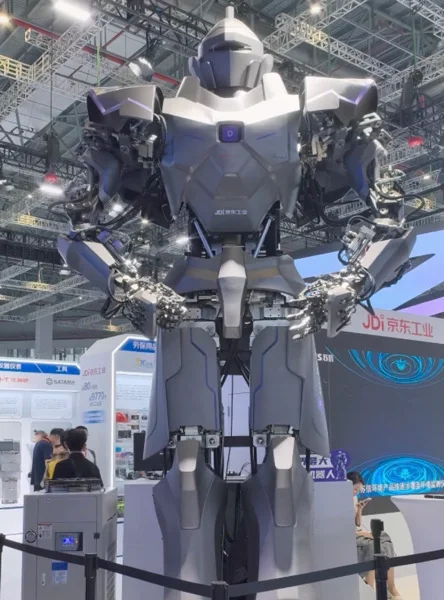
A Beijing robotics startup has shown off one of the largest humanoid robots yet. NeodraDynamics' Neo1 stands about 4 metres (roughly 13 feet) tall and, according to the company, can lift a combined 500 kg (about 1,100 pounds) with its two arms. Unlike most humanoids, it is powered mainly by hydraulics rather than electric motors.
Key points
- Neo1 was shown at the China International Industry Fair (CIIF) in Shanghai in October 2026, alongside partner JD Industrial.
- It first appeared at the World Robot Conference in Beijing in August.
- The company says it is about 4 metres tall and weighs 1.2 tonnes, with 41 active joints, 39 of them hydraulic.
- NeodraDynamics claims a 500 kg two-arm payload. That figure has not been independently tested.
- No price, delivery date or customer deployment has been announced.
What NeodraDynamics revealed
Interesting Engineering reports that NeodraDynamics unveiled Neo1 with JD Industrial at the 2026 CIIF. According to Aparobot, the company's press release of October 14 names JD Industrial as a partner for pilot projects. JD Industrial will provide supply chain and real-world testing scenarios.
The robot has 41 active degrees of freedom. Thirty-nine of those joints use small digital hydraulic actuators that NeodraDynamics makes itself. The two rotation joints in the forearms are electric, where precise turning matters more than raw force.
The company says each actuator weighs about 1 kg (2.2 pounds) but produces "ton-level" continuous thrust. That combination is what would let a humanoid lift loads in the hundreds of kilograms.
The numbers, and why they need caution
Several outlets have pointed out that the figures come from the company and have not been verified:
- Height and weight: about 4 metres and 1.2 tonnes, according to the company. Behind Robotics notes the weight appears only in the October press release headline. Some reports convert it to about 2,400 pounds. In metric tonnes it is closer to 2,650 pounds.
- Payload: a claimed 500 kg (about 1,100 pounds) with two arms. Behind Robotics says that is about 3.4 times the strongest humanoid in its database.
- Precision: the company has published different accuracy figures in different places, from ±0.05 mm in September to ±0.005 mm in October. None of them says what load or test conditions were used.
Aparobot puts it plainly: the robot has been physically shown at two trade events, but the payload, thrust and accuracy figures "are the company's own and have not been independently tested."
What it is meant to do
NeodraDynamics is aiming Neo1 at work that is heavy, dangerous or both. According to Interesting Engineering, its intended uses include:
- assembling heavy components and moving cargo at ports;
- handling fuel and maintaining equipment in nuclear plants, using radiation-resistant hydraulic modules;
- subsea maintenance under high water pressure;
- mining, demolition and clearing debris after disasters.
These are intended capabilities, not confirmed deployments. Interesting Engineering notes that field testing would need to show the robot's endurance and reliability.
Why hydraulics?
Most modern humanoids, such as Tesla's Optimus, use electric motors. They are quieter, cleaner and easier to control precisely. Hydraulics push oil under high pressure to move a piston, which gives a lot of force from a small, light part. That is why diggers and cranes use them. The downsides are pumps, hoses, seals, possible leaks and more complex maintenance.
Boston Dynamics famously used hydraulics in its original Atlas robot before switching to an all-electric version in 2024. NeodraDynamics is betting that for very large machines doing heavy work, hydraulics still make sense. Behind Robotics describes Neo1 as "closer to a hydraulic excavator than to Optimus."
Who is behind it
Interesting Engineering reports the company was founded by engineers with backgrounds at Tsinghua University. Founder Yang Tao said the goal is not to copy human anatomy but to build robots that exceed human physical abilities and do jobs people cannot safely do. The company calls Neo1 a "super humanoid."
Why it matters
China is investing heavily in humanoid robots, and Neo1 shows a different direction from the human-sized machines that get most of the attention. If its claims hold up, a robot like this could take people out of some of the most dangerous industrial jobs. For now it is best seen as an impressive prototype. The thing to watch is whether the JD Industrial pilots produce published results with real sites and hours of operation.



Comments